
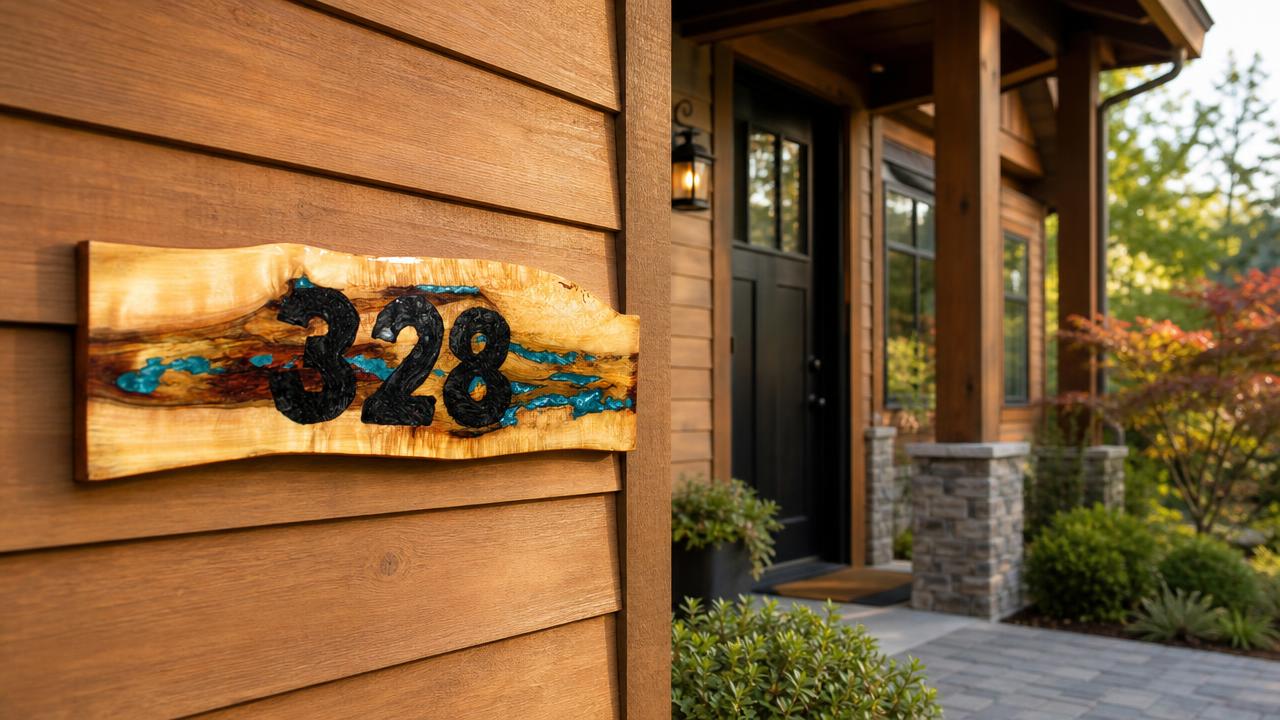
Your front entrance is the first thing a guest, a delivery driver or a neighbour reads about your home. Most of us fill that spot with a stock plate from a hardware store and never think about it again. A custom live edge house number sign does something different. It tells people a real person made a choice here.
At DD's Custom Woodworks in Kelowna, BC, I build house number signs from live edge wood, with carved numerals and epoxy accents. After 18+ years building luxury custom homes, I have spent a lot of time thinking about how entrances work: where the eye lands, what reads from the street, and which small details make a house feel finished. A good number sign sits right at that point.
Why live edge works for an address
A live edge board keeps the natural outline of the tree. No two have the same curve, grain or colour, so your sign cannot be matched by anything off a shelf. Add epoxy accents and the grain becomes a feature: colour can run through the knots and gaps in the wood, and the numbers sit on top of a surface with real depth.
The result sits somewhere between house signage and a small piece of art for your front wall, post or gate.
Plan it like a sign first, a piece of art second
A house number has a job. Before you fall in love with a board, work through these five questions.
1. Visibility: who needs to read it, and from where?
Think about the real viewing distance. A number read by a guest at the door can be smaller than one meant to be read from the road or a driveway entrance. Stand at the spot where someone would first look for your address, then picture reading it from there, in daylight and after dark.
2. Size: bigger numerals, simpler shape
The numerals drive the size of the sign, not the other way around. Longer addresses need more width, and a very wavy live edge can eat into the space available for characters. It is worth deciding how many digits you need to fit, then letting the board follow. A clean, bold numeral style is easier to read at a glance than a decorative one.
3. Contrast: the numbers have to stand out from the wood
This is where a lot of handmade signs go wrong. Figured wood and colourful epoxy are beautiful, but they are also busy. Dark numerals against a lighter board, or the reverse, usually read more clearly than numbers that sit close in tone to the surface behind them. Epoxy colour works best as an accent around the numbers instead of competing with them.
Think about the wall or post behind the sign too. A dark sign on dark siding loses its outline, and a light one on a pale wall can wash out.
4. Placement: eye level, clear sightlines, a calm background
Common spots include beside the front door, on a post at the end of the walkway, on a gate or on a wall facing the street. Check that nothing blocks the line of sight, such as shrubs, railings or porch posts. Try to keep the sign near eye level and away from visual clutter, so the number is the clear focal point.
Lighting matters as well. A sign near a porch light or sconce is easier to read in the evening than one in a dark corner.
5. Suitability: match the piece to the location
A covered porch wall, an open post by the road and a garden gate are different environments. Mounting method, exposure and the style of your home all affect which design makes sense. Tell me where the sign will live and I will talk through whether that location suits the piece, and how it should be mounted, before we settle on a design.
Make it personal
This is the part I enjoy most. A few directions people often consider:
- Match the home. Tone the wood and epoxy colour to your siding, trim or front door.
- Pick a colour with meaning. A favourite colour, a nod to a lake or a forest, or simply a shade that suits your entrance.
- Keep the address front and centre. The sign can be as expressive as you like, as long as the number is easy to read.
- Think of it as a gift. A new home, a cabin or a family milestone all make a custom sign a thoughtful present.
What to bring when you ask for a quote
You do not need a full design. A few details help me understand the project:
- Your address numbers, or the name or text you want on the piece
- Where it will be mounted (wall, post, gate) and a photo of that spot if you can
- Roughly how far away it should be readable
- Any colours you like, or the colours of your siding and door
- Anything else you want it to say about you or your home
From there we can talk through size, contrast, placement and whether the location suits the piece.
Ready for an entrance with some character?
If you are picturing a sign that looks like it belongs to your home and nobody else's, I would like to hear about it. Send a quote request through the form, choose "Custom Name or Address Sign," and tell me about your entrance.
Darren Dyck, DD's Custom Woodworks, Kelowna, BC
